Britain is unusually good at keeping its legends in the ground. A stone circle, a ruined abbey, a cave mouth in a limestone gorge — the story tends to be attached to something you can stand next to, touch, and photograph badly in the rain. Folklore here is not confined to books. It lives in place names, in parish boundaries, in the habit of leaving a coin on a stone.
What follows is a checklist rather than a ranking. Twelve sites, spread across England, Scotland, Wales and Northern Ireland, chosen because the folklore is substantial and the visit is genuinely worthwhile. Tick them off over a few years. Take waterproofs.
1. Tintagel Castle, Cornwall
The default starting point for Arthurian geography. Tintagel's association with King Arthur was popularised in the twelfth century by Geoffrey of Monmouth, and the site has been trading on it ever since. What you get is a headland split by sea, a footbridge across the gap, and the faint but persistent sense that the cliffs have been used as a stage set for a very long time.
Look for Merlin's Cave below the castle, reached by steps from the beach and passable at low tide only. Check tide tables before you go down; people are caught out here every year. The walk from the village is steep, and there is a landrover shuttle for those who need it.
2. Glastonbury Tor and the Isle of Avalon
Somerset's Tor rises out of flat ground like something deliberately placed, which is roughly how the legends treat it. Avalon, the apple orchard where Arthur was taken after his last battle, has been identified with Glastonbury since medieval monks conveniently discovered a grave there in 1191.
Climb the terraces and the tower of St Michael's, all that survives of a church that fell in an earthquake in 1275. The terraces themselves are old field systems rather than a mystical labyrinth, but the folklore has been layered on thickly and honestly, it is a fine place to stand at dusk and think about monks, kings and hoaxes.
Also worth a detour
- Chalice Well Gardens — the spring associated with the Holy Grail, red-stained from iron in the water.
- Gog and Magog — two ancient yew trees on Wearyall Hill, linked to Joseph of Arimathea.
- The White Spring — a short walk from the Red Spring, and a very different colour.
3. Avebury, Wiltshire
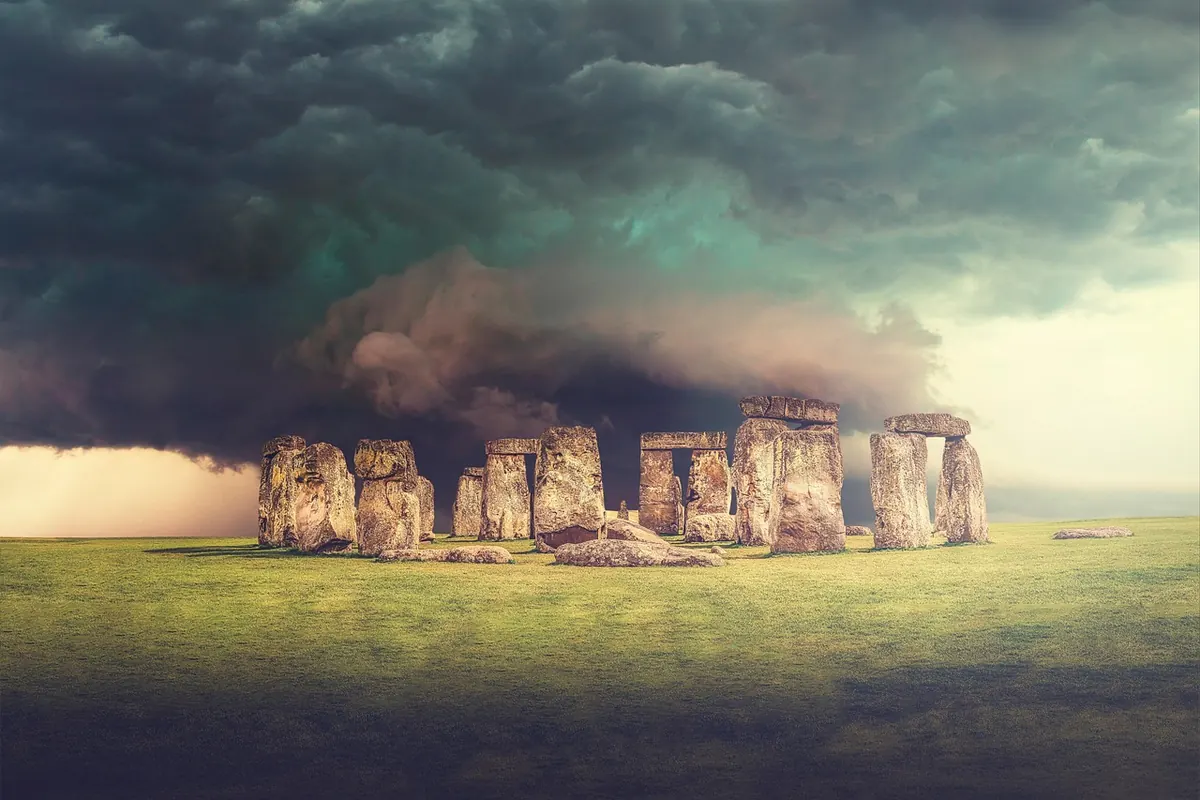
Less famous than Stonehenge and much easier to enjoy, Avebury is a henge with a village built inside it. You can walk among the stones, lean on them, and have a cup of tea in the middle of a Neolithic monument. The folk stories here are the classic ones: stones that cannot be counted, stones that walk to the river to drink, and a circle that was once a wedding party turned to rock for dancing on a Sunday.
The National Trust car park is the practical starting point. The Ridgeway path passes nearby, and Silbury Hill and West Kennet Long Barrow are both within a reasonable walk if you have the legs for it.
4. The Rollright Stones, Oxfordshire
A tight, atmospheric group of monuments on the Oxfordshire–Warwickshire border, with a story that is easy to remember. A king and his army were marching across the country when a witch told them that if they could see Long Compton after seven long strides, they would be king. They could not. The king, his men and his knights became the King Stone, the King's Men and the Whispering Knights.
The Whispering Knights, a burial chamber, are said to move when the church clock at Long Compton strikes midnight. Do not try to count the King's Men either — the legend is that the total never comes out the same twice. The site is small, quiet and free to enter, with an honesty box for parking. Combine it with a walk on the Cotswold escarpment.
5. Bosworth Field and the Grey Lady
Leicestershire's Bosworth battlefield, where Richard III fell in 1485, is a good example of history hardening into folklore within a generation. The battlefield centre and the nearby church at Dadlington, where bodies were reportedly taken, are the anchors. The most repeated story is of a grey lady seen near the site, and of the king's own ghost at nearby Ambion Hill.
The walk between the visitor centre, the sundial monument and the well is straightforward and well signposted. Read a little about the battle before you go; the landscape makes far more sense once you know which way the marsh lay.
6. The Screaming Skull of Bettiscombe Manor, Dorset
A single skull, kept in a farmhouse, said to scream if removed. This is the sort of story that British folklore does better than anywhere else: domestic, specific, faintly ridiculous and oddly chilling. The Bettiscombe skull is traditionally said to belong to a West Indian servant who begged that his body be returned home, and whose skull, left behind, protests loudly whenever it is moved.
Bettiscombe Manor is a private house and not open for casual visits. Treat this entry as one for the folklore reading list rather than the day-trip list, unless you are passing on the Jurassic Coast and simply want to know what you are looking at.
7. The Devil's Bridge, Ceredigion
Three bridges stacked one above the other over the Mynach falls, and a story to match. The devil was tricked by an old woman into building the first bridge in exchange for the first soul to cross it. She threw a loaf of bread across, and her dog ran after it. The devil, outwitted and furious, abandoned the project.
You can walk down to the falls on a network of paths and steps. It is steep, wet and genuinely beautiful. Wear shoes with grip, and remember that the stone steps get slippery in autumn.
8. The Green Children of Woolpit, Suffolk
Two children with green skin, speaking an unknown language, appeared in a village in twelfth-century Suffolk. The boy died; the girl learned English, said they came from a land of perpetual twilight called St Martin's Land, and reportedly lost her colour as she ate ordinary food. The story survives in the chronicles of Ralph of Coggeshall and William of Newburgh, and no fully convincing explanation has ever been agreed.
Woolpit is a village, not an attraction. There are two ponds traditionally linked to the story and a church worth a look, but the reason to go is to stand in the place and let a very odd tale settle on you.
9. Loch Ness, Highlands
The most famous monster in Britain, and the folklore around the loch is older and more interesting than the twentieth-century newspaper coverage. Early accounts describe a water beast, and local storytelling long treated the loch as a place where something lived. Whether or not you believe any of it matters less than the loch itself, which is enormous, cold and surrounded by hills that make the question seem reasonable.
Urquhart Castle is the obvious viewpoint. Boat trips run from Inverness and from the loch's southern end. The main practical warning is weather: visibility can go from wide open to nothing in twenty minutes.
10. The Whistling Stones: Castlerigg, Cumbria
Castlerigg stone circle sits on a plateau near Keswick with a ring of fells around it, and it is, by common agreement, the finest setting of any stone circle in England. The folklore is thinner here than at Avebury or the Rollrights, but the tradition of stones that cannot be counted holds, and local tales speak of the circle being used for gatherings and of lights seen among the stones at night.
It is a short drive from Keswick and a good walk from the town if you are feeling energetic. Sunset is the right time. Bring a torch for the walk back.
11. Dunvegan Castle and the Fairy Flag, Skye
The MacLeod family's banner, kept at Dunvegan Castle, is said to have been given by a fairy and to hold three uses in battle. Twice, by tradition, it was unfurled when the clan was in danger; the third remains. The silk itself is thought to be of Middle Eastern or Central Asian origin, which only makes the story better.
Dunvegan is a working castle with gardens and boat trips to seal colonies. Check opening times, which vary by season, and allow a full half-day.
12. The Giant's Causeway, County Antrim
Basalt columns running into the sea, and two giants to explain them. Fionn mac Cumhaill built the causeway to reach Scotland and fight Benandonner, then disguised himself as a baby when the Scottish giant arrived. Benandonner saw the size of the "child" and fled home, tearing up the causeway behind him. The same geology turns up on Staffa in the Hebrides, which the story accounts for neatly.
Use the visitor centre and the shuttle bus if the walk down is too much; the stones themselves are free to visit, but the centre charges. The clifftop path to the amphitheatre is the better route if you have time.
Making the trip work
A few habits will save you trouble. Check opening hours before you travel — many of these sites are seasonal, and several castles close entirely in winter. Coastal and upland sites change character with the tide and the weather, so look at both forecasts. Where a place is on private land or is a working farm, keep to paths and read the signs.
Take a small notebook. The best part of visiting legendary places is noticing the details that never make it into the guidebooks: the coin left on a stone, the ribbon tied to a branch, the way a local tells a story slightly differently from the printed version. That is the folklore still being made. And if a site falls into the "reading list" category rather than the day-trip one, do not force it. Some legends are best kept at a distance.
Photo: ELG21 / Pixabay